
The Hidden Power Behind Beautiful Websites: Why Design Still Sells in 2025
Introduction
In 2025, website design is a force driving sales strategy that every brand needs to boost their digital presence. A great website design turns visitors into lifetime customers, as it is the first impression a visitor encounters before exploring the site. It builds and retains credibility and trust to every user to give them a seamless user experience.
An exceptional website layout ensures that first visitors and users of your site can easily navigate the site all-round without confusion or frustration.
5 Key Psychological Principles of Website Design
Humans naturally react to visuals; that’s why website design psychology plays such a big role in shaping people’s behavior. The core elements of design, like color, layout, and typography, often influence how consumers feel and respond. They help users build trust, credibility, and lasting connections with a brand.
Here are five key psychological principles of website design you should know:
-
Hick’s Law: According to Hick’s Law, when visitors are presented with too many options, they tend to leave without taking a desired action.
-
Fitts’ Law: This law emphasizes the time people take to click on a site, depending on the size and distance of clickable items. Engaging elements help people explore a site with ease.
-
The Von Restorff Effect: People often remember things that stand out. Designers use this principle to draw attention to important elements like discounts, call-to-action buttons, or headlines.
-
The Pareto Principle: This principle shows that a small part of your design, maybe 20%, 80%often drives most of your engagement or sales. It’s a reminder to focus on what truly matters.
-
Social Proof: People are encouraged by what others have already tried and trusted. When users see that others have achieved good results, they naturally want to follow the same path.
It’s what a business or organization is known for – MTN is known for yellow, while Airtel is known for red. That’s why Arushi Web Solutions is represented with blue; so any visitor or user that navigates their site would easily know what they represent, digital marketing and web development agencies providing clients with the best digital services.
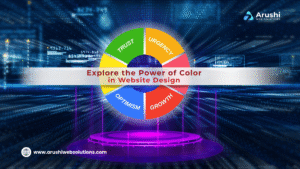
In website design, various colors are used to tell visitors and users what a brand stands for. For example, Facebook is known for blue, so anyone who comes across an “F” with blue can tell it represents Facebook. Color and website design are closely connected because, without color, any brand or business can hardly exist in the digital space. Without color, there would be no design, and color truly remains the foundation of website design.
Why Website Design Still Sells in 2025
Even in the era of digital evolution, which has brought about AI and automation, website design in 2025 is integral to every business that needs to thrive digitally.
For a brand to establish a reputable online presence, a well-crafted design with a user-friendly interface and functionality is needed — be it a school, church, or organization, a website is core to a brand’s global visibility. Organizations with poor website design lose potential customers before they explore their site.
Core Element of Web Design
There are different elements that work together to make a website design look beautiful and easy to navigate.
Here’s a breakdown of these elements:
Layout: This automatically directs a user on what to do on a site with clarity. It comprises text, images, buttons, and menus, which help users and visitors decide what actions they want to take.
-
Color Scheme: Colors appeal to users’ emotions and brand awareness. The right color boosts brand recognition and visibility.
-
Typography: Using legible fonts and spacing helps convey the brand’s tone, whether it is formal or informal, and enhances the site’s readability.
-
Images and Graphics: Using quality images and infographics connects users emotionally and brings your website to life.
-
Navigation: A well-designed site helps users navigate through any part of your site without chaos.
-
Responsiveness: A responsive site fits any screen– phone, tablet, or computer — so that every visitor has a smooth experience.
-
Consistency: Consistent use of fonts, colors, and buttons showcases a brand’s uniformity and helps people build trust with the brand.
The Future of Website Design in 2025 and Beyond
As website design keeps evolving over time, website designers who cannot incorporate cutting-edge technologies and concepts to craft a design will be left out. The future of website design is artificial intelligence, automation, and emerging technologies and digital tools that make website design more efficient and less time-consuming.
-
Why Website Design Will Always Sell
No matter how technology changes, website design will always help a brand keep selling. A stunning website converts, captures attention, and builds engagement.
Now is a good time to look at your site. Imagine how a better design could transform your business, raise your brand’s visibility, and bring more visitors.